Keeping Our Focus in the Digital Age
This blog is being released as a primer for the second workshop in series that Dr. E Curl-Woodruff of Thompson Therapeutics & Mediation is hosting at the DeKalb Public Library on the third Tuesday of each month, from July to October, with Dr. E covering a sub-topic in each. This blog post supports the second workshop which will take place on August 18 at 6pm. Participants may attend one, some, or all sessions for FREE. For more information, go to: https://dkpl.org/events/#/events/Ee0jjiOlKf/instances/haGdoUdCBW/
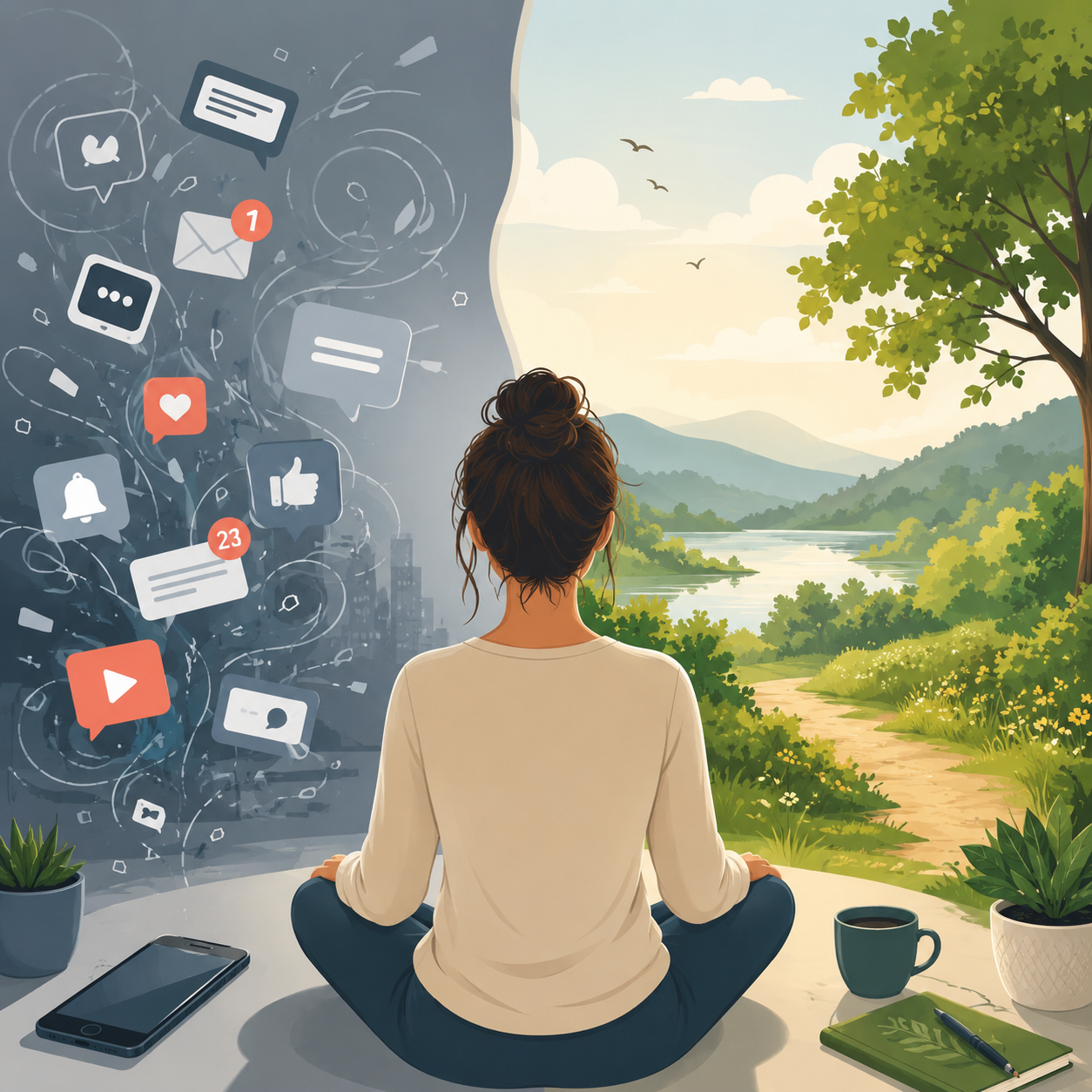
Our day starts like any other. You wake up in the morning, look out the window, and wonder what the weather will be like. Before we even roll out of bed, we may hop onto our wireless phone to check the weather app. But before we even get to the app, we see there’s a notification for one of our many social media accounts. We find ourselves anxious to find out what it is, so we tell ourself we’ll quickly check to see what it says. We may respond or we may not, but along the way, we may notice something someone else posted, or decide to check our other social media accounts to see what our other friends are up to. Maybe we see an advertisement for an online t-shirt store and start shopping for a gift for a birthday that’s coming up, or maybe we get caught up in watching some cute cat videos or a clip from a political speech the night before. Suddenly, we look up to see that minutes or even hours have passed. We are horrified to realize we can barely remember what we actually accomplished while the time passed. Then we look out the window and again wonder what the weather will be like, still never having checked the weather app.
While this exact scenario might not be an exact replica of our experience, it’s likely something similar has happened to us in recent years. Perhaps we’ve gone to complete a task in our house or walked into a store and had our mind go suddenly blank as to why we were there. Maybe we’ve waited in a line for an event or been at a party and found ourselves checking our phones instead of talking to the people around us. Maybe we feel like our days and weeks fly by, with very few memories separating one from the next.
It’s Not Just You!
If you feel like you can’t focus, you are not alone. In a study by The Ohio State University, 75% of respondents reported having trouble with their attention spans (2025). And at least 7% of US Adults reported their impairment as causing significant cognitive impairments according to a 2025 article by Wong et al, with the sharpest increases happening in respondents who were ages 18 to 39.
When attention spans are studied in laboratories, scientists primarily measure the amount of time a person can interface with a specific task or activity without changing focus. If that is the main measure, it should be noted that many people cannot hold that attention for more than a minute, and that the idea that people can multitask has actually been disproven. And yet, many people in the US believe that they can juggle multiple tasks at once, all while being interrupted by other people in their immediate surroundings, fielding incessant dings from multiple personal devices, and in some cases, trying to filter out noises and other sensory stimuli that come from living and working in crowded areas.
Many assume that their lack of focus is a personal failure or lack of discipline, and attention-related diagnoses are on the rise. Regardless of whether there is a diagnosis or not, there are actually several very real biological and physiological reasons that make it more difficult than ever before to focus and, thankfully, a number of things that we can do both personally, and in groups, to improve.
Frustrated Biological Objectives
The last major changes to the human brain and body occurred between 30 and 50 thousand years ago when human beings lived in very different circumstances than today. As hunters and gatherers, our brains had to be curious about our environments and respond quickly to new stimuli to determine if it was a threat. We were highly dependent on our relationship with nature and a couple dozen other people for survival. Thus,we were very attuned to information offered by all our senses as well as social cues we saw in others. Finally, we had lots of time for rest and recreation, thinking about our past experiences, and innovating and imagining what might happen in the future.
It was only when our environments changed radically first with the agricultural revolution about 12 thousand years ago and then again with the industrial and technology revolutions that these innate behaviors and our associated biological objectives became mismatched with the modern environment. On farms and in factories, we moved around less and less and worked harder and longer than ever before. Living in larger groups, we had to know more people – a whole town instead of just a small tribe – and streamline the number and types of tasks we performed in a day. Our innate curiosity was stifled, more and more information overwhelmed our brains, and everything became very repetitive. In a sense, the environmental mismatch meant that our brains became frustrated by not being used the way they had evolved to do.
Keeping Our Focus in the Digital Age
Loss of focus in a common complaint, because it is largely due to larger social shifts – not individual failings. In fact, separating our ability to focus on and manage tasks from any negative judgments about ourselves is one of the first and most fundamental things we can do to start addressing the problem. This is because when the parts of our brains responsible for feelings of self-worth are triggered, the areas that might help us address the tasks at hand are deprioritized in favor of those responsible for survival. The longer we have associated our ability to manage and complete certain tasks with our self-worth, the harder it can be to decouple the two ideas. Long term associations can create physical neural connections between the two areas of our brains – meaning that one idea may trigger the other in a way that feels very difficult to interrupt. However, there are a few things we can do to help ourselves and others with this process:
Use Technology Wisely: While technological innovations have done a great deal to increase our quality of life, there is a great deal of research suggesting that many corporations exploit neuroscientific principles to command our attention and, in doing so, increase their profit margins. Thus, limiting the quantity and quality of time we spend in front of our screens, especially apps that allow for the “endless scroll” or have lots of colorful pop-up ads, is a practice that is likely to help us focus better. This may mean such simple actions as avoiding short-form content, putting time limits on certain apps, and spending time away from screens altogether – especially just after waking in the morning and just before going to bed. Each of us has to determine what is feasible in the context of our professional and personal responsibilities and what technology-related habits seem to impact us most negatively.
Challenge Our Brains: We used to believe that most people’s brains didn’t grow much past the age of 25, but we now know that our brains continue to adapt to the challenges we put in front of them all the way through the lifespan. So if we are struggling with attention, we can actually train them to be better by challenging them to do so. This may mean engaging in activities that increase the quantity or quality of our focus or both. Examples include practicing mindfulness meditations that force us to stay in the moment while observing our senses. We can also try to learn new things – ideally via long form media that force us to actively think about what we are learning as we learn it. An example would be to read a book on a subject rather than simply accept a short-form video’s content as true. Another would be to take a class or workshop with others, so we can discuss nuances of a subject and come to new understandings by encountering new viewpoints.
Leave Time to Get Bored: Human beings created complex societies, because we had lots of time in our day to think about various ideas - both consciously and subconsciously – and we didn’t feel the need to fill every moment. Allowing ourselves unstructured time in a day to simply let our minds wander may feel like a luxury, but it is a great investment, as it often leads to new ideas and connections. We should resist the urge to pack our calendar with activities, and try to avoid turning to distractions anytime there is a lull in our day. A good experiment is to try waiting in line without checking our cell phone for messages or playing the latest game. We can take a walk in nature or hang out at the park without ear buds playing music or a podcast. We can also resist always needing a goal for our activities by doodling on a page without worrying about creating a specific image or dancing in our living room without executing a specific choreography.
Move Our Bodies (Even a Little): Our modern lifestyle allows us only a fraction of the movement that our ancestors engaged in as a fact of daily life, but research suggests that moving our bodies is one of the best things we can do to increase our ability to focus. This is due to two primary mechanisms – one being how it increases circulation of blood and oxygen, regulates our metabolisms, and washes our brains in neurotransmitters that help our brains work optimally. Another is that movement – particularly movements that are new to us or challenge our coordination and balance – strengthen the sections of our brain responsible for memory, attention, and problem solving. In other words, a 5 minute walk around the block or a few jumping jacks can help us, but trying a new sport or improving our balance and coordination through yoga or pilates may actually do more.
Create Better Conditions for All Brains: It can be really hard to adopt habits that improve our focus when we are living in environments that drive the opposite effect, so it is important that we work together to advocate for systems that are conducive to adopting these habits for ourselves and encouraging them in others. We can tell our school boards that we want our children to have adequate time to move around, play, and engage their curiosity. We can try to find work with companies that encourage work/life balance, celebrate curiosity and innovation, and allow us to feel safe and valued. We can also intentionally create social and recreational situations where both adults and children engage in activities that limit use of technology, employ our social skills, and challenge our brains to do new things. Finally, we can insist that the government create limits on how tech companies exploit neuroscientific principles to command our attention as a way to increase their bottom line.
++++++++++++++++++++++++++++++++++++++++++++++++++++
Interested in learning more about your brain and tools that can make it healthier? Please join Dr. “E” Elisa Curl-Woodruff at the DeKalb Public Library on August 18, 2026 at 6pm for a free interactive workshop on this subject.
If you are interested in more individual attention, E is now taking new clients. You can set up an appointment by calling 630-297-7559.